Shape-shifting
Or transitions to modernity

Between 1937 and 1939, the Irish Free State started a schools folklore project, asking teachers and students to write down the stories of the largely elderly men and women of their districts, districts that in the last hundred years had been ravaged by famine, disease, civil war and their children escaping from them.
One of them was my grandfather. I don’t know the exact date but as these exercise books were being filled, he was starting to make a life for himself across the sea. In many ways, my grandfather was a shape-shifter. He made himself fit for any work that was available. When we flew from Manchester Airport in the 1980s, his socially-mobile son would tell us, his grandchildren, that Grandad had built it and I really, truly believed that he had done it all by himself, such was my faith in the man.
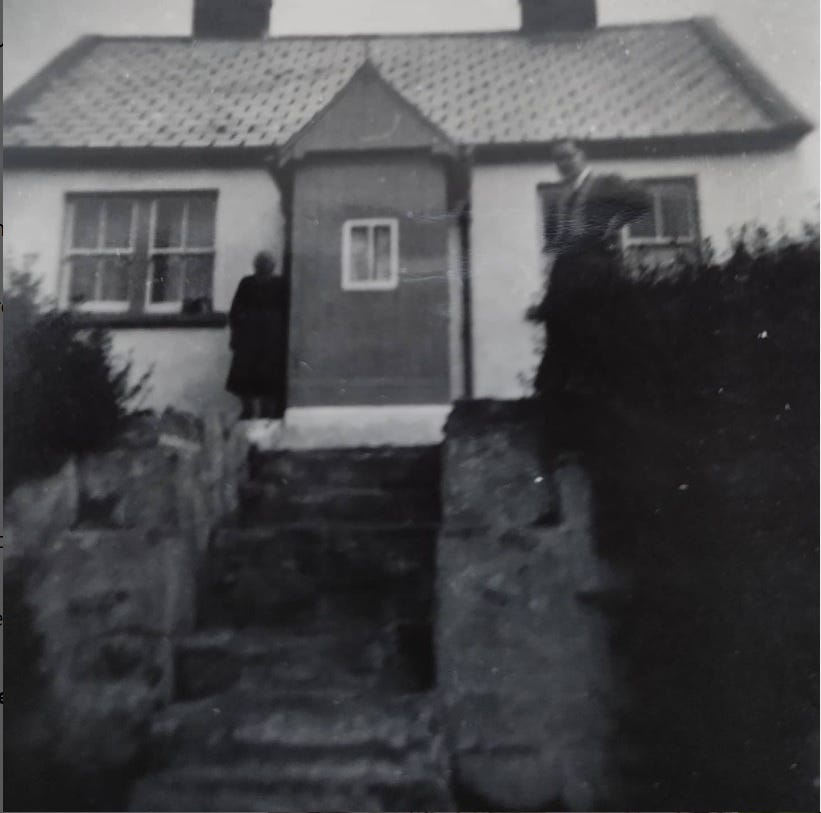
In the book for Tullaghan, Granddad’s village on the Leitrim/Donegal border in the North West of Ireland, there is a single entry for Owen Feely, aged 60 from Wardhouse. (This tiny village was split up further into even tinier areas: Wardhouse/Upper Wardhouse/Lower Wardhouse.) I had hoped that the only glimpse I would get of my great-grandfather beyond patchy official records would be profound. What I got was a English, Irish and Scotsman joke:
One day there was an English man an Irish man and a Scotch man drinking in a Bar. The English man and the Scotch man were getting in all the drink. They would not let the Irishman get in any. But they intended to make the Irish man pay for it all. When he had found out the trick they had played he asked the Bar man did he ever see two sorts of whisky taken out of one barrel. The Bar man said that that was a thing impossible. All right said the Irishman come down to the cellar. They both went down to the cellar. The Irishman bored two holes on the barrel. He told the Bar man to put his two hands on that till he would get two glasses. When he reached the Bar he wrote a letter telling the first one that would come in where he would get the Barman.
Owen Feely, aged 60
Wardhouse
But I realise now that the Irishman isn’t the butt of this joke: he sees the situation and uses his resourcefulness to dust himself down and move on.
This is a story of shape-shifting. Of people caught in the transition to modernity and making the best of it, of getting by and getting on.
Another story in the exercise book pertaining to the village of Glenade, headed ‘A Local Hero Story’, tells an older tale of shape-shifting. It’s long and meandering and you might not know where it is, or indeed I am, going but that’s kind of the point. I have added paragraph breaks to save you a little sanity.
Long ago before the advent of Christianity there lived in Glenade a chieftain named Tom Feely. He owned the greater portion of the Glenade. Consequently he was very wealthy. His family consisted of one son, who was very easy going and did not reach the standard of cleverness his parents wished. The fact of the son's stupidity gave rise to a great deal of anxiety, and Mrs Feely, one day said to Tom that they should take him on a visit to a friend in Tullaghan, a place at the extreme end of Co Leitrim as this visit might improve his education.
As they were walking along the seashore they saw a man, who was a stranger to Tom and his son land off a boat. He spoke to Tom and asked him if the boy with him was his son. Tom replied that he was but that he was not what his wife or he would like him to be as he was rather stupid. The man said that if they would give him the child he would keep him for a year and then take him back one of the cleverest men in Glenade. When Tom told his wife this, she was in deep distress at the thought of parting with her only child, but she had only to wait patiently for the year to elapse.
At the end of the prescribed time Tom again visited Tullaghan. When he reached the seashore the same man came in with the boat and his son with him. But what seemed very strange to Tom was that his son did not speak. The man then said to Tom that he promised to bring back his son but that he did not promise to give him to him. Turning the boat he then rode away from the shore. Tom was grieved and would not go home to his wife without their son. Seeing a small boat near by, he boarded it and went in pursuit of his son; and after a time he reached an island. He then looked round and saw his son coming towards him. The son said to his father that if he did as he told him he would succeed in his efforts to get him away. He told his father to sit at dinner when asked, cut the meat with his knife, take it on the fork replace it on the plate and that he would not eat until he got his son. A bag of wheat would be thrown on the floor and a number of pigeons would fly down and eat it. By looking closely at them he would notice a feather of one of the pigeon's wings raised up. This pigeon was his son. When dinner was over he found the pigeon after a careful search and brought it with him and they found that he become a very clever boy.
One day he went to the races and he changed himself into a horse and won all the races. He told his father that gentry from all arts would be there and would strive to buy him but on no account to sell the bridle. Everything happened as the son stated and when the bargain was complete he took the bridle off the horse and on returning home his son was there before him. He attended all races after that with a like result. One day they flattered poor Tom in such a way that he forgot the bridle and went home without his son. They took Tom back to the Island and for punishment they left him standing in a door with boiling oil pouring down on him. One day he asked a man to throw three buckets of water on him and as he so the spell was broken and Tom's son made an escape. They went in pursuit of him. He turned himself into a fish and although his followers changed themselves into sharks he landed safely on land. When on land he turned himself into a hare and his followers gave chase in the form of hounds. Near the river Duff he changed himself into a field of corn. They cut the corn and thrashed it. The particular grain in which he was hidden rolled into the river and nothing remained of the corn but the chaff. In the river he turned into a trout and his followers changed themselves into salmon and went in pursuit of him. At Muckrum they closed in on him but getting out of the river he turned into a hawk and his followers followed him in the form of eagles. When he reached Loughmarron they were about to capture him. He turned towards his home and got there in safety. From that day to this the hawk is able to beat the eagle in the air.
P.J. Rooney – Farmer. Age 60 years.
Glenade, County Leitrim.
Shape-shifting. A fish, a hare, a field of corn and the hawk that always beat the eagle.
The Schools Folklore Stories was an amazing idea. This should be standard practice in our world. Love your grandfather’s story too. Thank you for sharing it.